SHARE
SHARE


It’s Tuesday morning. Your phone buzzes with a rate request: Shanghai to Hamburg, 40-foot container, needs quote ASAP. You open your email, scroll through last week’s messages looking for that Maersk rate sheet. Was it the one from Monday or Wednesday? You check your shared drive. Nothing. You call your pricing manager. She’s in a meeting. You try another carrier. Their rep says they’ll get back to you in an hour.
Three hours later, you finally piece together a quote and send it to the customer. They respond: “Thanks, but we already booked with another forwarder who quoted us in 15 minutes.”
Sound familiar? This scenario plays out hundreds of times daily across freight forwarding companies worldwide. While you’re hunting through emails and waiting on carrier responses, your competitors with real-time rate access are closing deals.
The gap between manual quoting and real-time systems isn’t just about convenience. It’s the difference between winning and losing business in a market where 90% of shippers expect digital quote turnaround in under two hours, yet most forwarders still take over six hours to respond.
The Cost of Slow Quoting in Today’s Market
Customers Expect Amazon-Speed Responses
Your customers live in a world of instant gratification. They track Amazon packages by the minute. They book entire vacations from their phones in seconds.
They get real-time updates on everything from food delivery to ride shares. Now they expect the same from freight forwarding.
When a shipper sends out rate requests, they’re not just contacting you. They’re reaching out to multiple forwarders simultaneously, comparing not just price but responsiveness. The forwarder who responds first with an accurate quote doesn’t just make a good impression. They often win the business before slower competitors even reply.
Research shows that responding to inquiries within 10 minutes makes your close rate 5-8 times higher than waiting 24 hours. That’s not a small difference. That’s the gap between thriving and struggling in today’s market.
Think about what happens when you tell a customer “I’ll get back to you tomorrow” on a quote request.
They’ve already received three instant quotes from digital platforms. Your delay isn’t seen as thoroughness. It’s viewed as inability to keep up with modern business expectations.
Every Hour You Wait, Competitors Quote
The freight forwarding market is more competitive than ever. Global maritime trade is expected to grow modestly, while carrier capacity expands significantly, creating intense competition for available cargo. In this environment, operational efficiency isn’t just an advantage. It’s essential for survival.
Digital-first forwarders are expanding rapidly, growing at rates that far exceed traditional operations. Why? Because they quote while you’re still searching for information.
They respond to every inquiry immediately, handle higher volumes without proportional staff increases, and offer customer experiences that match modern expectations.
Industry data shows that digital forwarders commonly double shipments while adding just 20-30% more staff. Traditional forwarding has brutal economics: double your volume, add 70-80% more people. Real-time systems break this cycle by automating routine work so you handle vastly more volume with incremental staffing.
What Real-Time Rate Access Actually Means
Real-time rate access is more than just fast quoting. It’s a fundamental shift in how freight forwarders access, manage, and use pricing information. But what does it actually involve?
Live Connection to Carrier Rate Databases
Real-time systems connect directly to carrier rate databases through APIs (Application Programming Interfaces).
Instead of manually downloading rate sheets, updating spreadsheets, and hoping your information is current, the system pulls data automatically from carrier systems.
Modern platforms like CargoFive connect with over major carriers serving global trade routes. When a carrier updates their rates, the change flows directly into your system. When they add a surcharge, it appears automatically. When they adjust fuel factors, you have the new calculation instantly.
This connection means your rate data is always current. Not “current as of last week when someone updated the spreadsheet.” Current as of this moment, right now, when you’re generating a quote for a customer.
Instant Updates When Carriers Change Pricing
Here’s a reality of freight forwarding: rates change constantly. Carriers adjust base rates, fuel surcharges fluctuate monthly, peak season surcharges appear and disappear, port congestion fees get added with little notice, and equipment imbalance charges vary weekly.
When you’re managing rates manually, these changes create chaos. You update Maersk’s rates on Monday. MSC sends new pricing on Tuesday. By Friday, you’re not sure which spreadsheets reflect current pricing and which are outdated.
Real-time systems eliminate this problem completely. Updates happen automatically. Your team always quotes with current information.
The system applies the correct surcharges based on shipment details. You never accidentally quote an expired rate or forget a newly added charge.
The difference is dramatic. Manual processes leave you constantly behind, trying to catch up with rate changes. Real-time access keeps you current automatically, protecting both your competitiveness and your margins.
| Quoting Approach | Manual Process | Real-Time Rate Access |
|---|---|---|
| Rate Search Time | 1-2 hours | 15-30 seconds |
| Rate Currency | Days to weeks old | Current to the minute |
| Surcharge Accuracy | Frequently missed | Automatically applied |
| Quote Generation | 2-4 hours per quote | 30 seconds to 2 minutes |
| Daily Quote Volume | 3-5 quotes per rep | 15-20 quotes per rep |
| Error Rate | 10-15% | Under 2% |
| Competitive Response Time | Hours to days | Minutes |
| Margin Protection | Low (outdated rates) | High (current pricing) |
| Customer Satisfaction | Frustrated by delays | Impressed by speed |
Why Quote Speed Directly Impacts Win Rates
The First Accurate Quote Often Wins
In freight forwarding, there’s an unwritten rule that sales directors know too well: first response advantage is real and substantial. When shippers request quotes, they’re evaluating more than just price. They’re assessing your responsiveness, professionalism, and operational capability.
A fast, accurate quote signals several things to customers. First, it demonstrates operational efficiency. If you can quote this quickly, you can probably execute shipments efficiently too. Second, it shows you value their time and urgency.
Third, it gives them a baseline price immediately, which influences their perception of subsequent quotes they receive.
Real-world data confirms this advantage. Companies implementing real-time rate systems report win rate improvements of 25-35%, with even higher gains on competitive lanes where multiple forwarders bid for the same business.
The psychology is straightforward. When a customer receives your quote in 15 minutes while waiting hours for competitors, they’re inclined to move forward with you unless competitors offer dramatically better terms.
Speed creates momentum toward conversion.
Response Time as a Competitive Differentiator
Price matters, obviously. But in freight forwarding, where rates are often similar across competent forwarders, other factors determine who wins business. Response time has emerged as one of the most significant differentiators.
Consider two scenarios. Scenario A: you respond to a quote request in 3 hours with a competitive rate. Scenario B: you respond in 15 minutes with a rate that’s 5% higher. Which wins more often?
In many cases, Scenario B does, especially with customers who value speed and reliability over squeezing every dollar.
Why? Because response time signals operational capability. Customers assume (often correctly) that forwarders who quote quickly also handle bookings quickly, provide updates proactively, and resolve issues efficiently. They’re choosing a business partner, not just a price.
The shift toward digital freight forwarding in 2025 is driven largely by customer expectations for speed and transparency.
Shippers track Amazon packages by the minute, book vacations from their phones in seconds, and expect the same responsiveness from their freight partners.
How Real-Time Systems Transform Daily Operations
From 2 Hours to 30 Seconds Per Quote
Let’s walk through what quote generation looks like with real-time rate access versus manual processes.
Manual Process:
- Customer sends rate request at 9 AM
- You check email for recent carrier rate sheets (15 minutes)
- Find Maersk rates but they’re from last month, so you email your account manager (5 minutes)
- Check MSC rates in shared drive (10 minutes)
- Call COSCO rep for current pricing (20 minutes, including hold time)
- Manually calculate surcharges for each carrier (25 minutes)
- Build comparison in Excel (15 minutes)
- Create and send professional quote to customer (10 minutes)
- Total time: 1 hour 40 minutes minimum, often longer if carriers don’t respond immediately
Real-Time Process:
- Customer sends rate request at 9 AM
- You open rate management platform (10 seconds)
- Enter origin, destination, container type (20 seconds)
- System searches all 25+ carriers instantly, applies surcharges automatically (5 seconds)
- Review options, select best rates (30 seconds)
- Add margin, generate professional quote (45 seconds)
- Send to customer (10 seconds)
- Total time: 2 minutes maximum
This isn’t theoretical. Real companies report these exact transformations. Kerry Logistics’ Tuvia Italia saw their quote response time drop from 2 hours to 15 minutes. Other forwarders achieve even faster turnaround, with some generating quotes in under 60 seconds for standard lanes.
Sales Teams Quote More, Win More
When quote generation takes 2-3 hours, your sales reps can handle maybe 3-5 quotes per day while also managing existing customer relationships. When it takes 2 minutes, they can handle 20-30 quotes daily without breaking a sweat.
This productivity multiplication has profound impacts. More quotes mean more opportunities pursued, faster follow-ups on inquiries, ability to service demanding customers who need multiple options, and higher total revenue per sales rep.
Freight forwarders using real-time platforms experience operational efficiency improvements of 40-60% and revenue growth rates exceeding industry averages by 25-30%. These aren’t marginal improvements. They’re transformational changes that redefine what’s possible for your business.
Sales teams also report higher job satisfaction. Instead of spending their days hunting for information and building spreadsheets, they focus on what they actually enjoy: building customer relationships, solving logistics challenges, and closing deals.
Real Customer Results
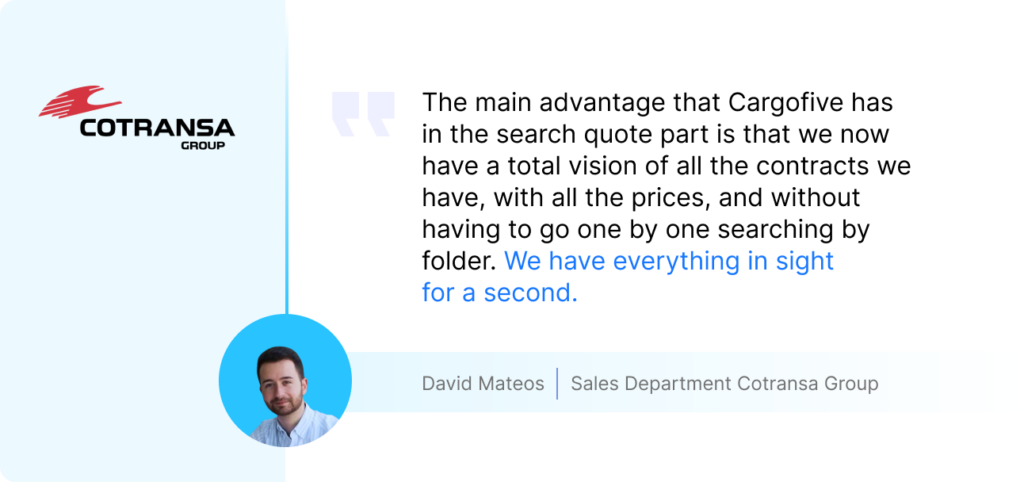
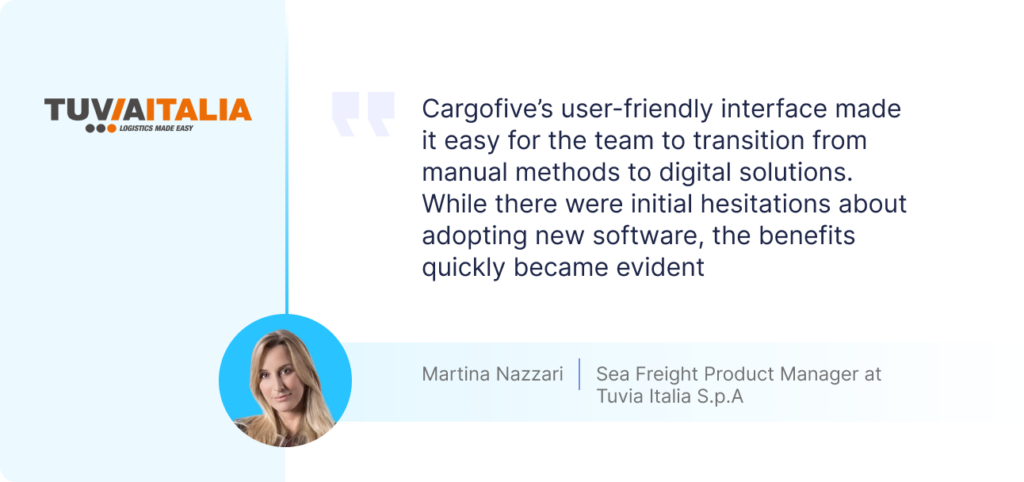
Before CargoFive, it could take up to two hours to respond to a quote. Now it takes just 15 minutes. The main advantage that CargoFive has in the search and quote part is that we now have a total vision of all the contracts we have, with all the prices, and without having to go one by one searching by folder. We have everything in sight for a second.
That’s how Tuvia Italia, a Kerry Logistics Company, describes their transformation. Read their complete success story.
The Technology Behind Real-Time Rate Access
API Integration with major Shipping Lines
The backbone of real-time rate access is API integration. APIs allow different software systems to communicate and share data automatically. When a carrier updates rates in their system, that change flows through the API to your rate management platform instantly.
CargoFive maintains direct integrations with over 25 major shipping lines, including Maersk, MSC, COSCO, Hapag-Lloyd, CMA CGM, and others representing the vast majority of global container capacity. These integrations mean rate data flows automatically without manual intervention.
The technology might sound complex, but from a user perspective, it’s beautifully simple. You don’t see APIs or data transfers. You just see current rates when you need them, updated automatically, accurate and ready to quote.
This integration extends beyond just base rates. Modern systems also connect to carrier APIs for schedule information, space availability, equipment positioning, and booking confirmations. The result is end-to-end visibility and control without manual data entry.
Automated Rate Validation and Updates
Real-time systems don’t just store rates. They validate them continuously. The system checks rate validity dates automatically, flags expired contracts for renewal, identifies missing surcharges, verifies that rate structures make sense, and alerts you to unusual pricing that might indicate errors.
This automation dramatically reduces errors. Manual rate management shows error rates around 15%. Automated systems achieve error rates below 2%. That 13-point improvement protects margins, prevents customer disputes, and eliminates the embarrassment of quoting rates you can’t actually deliver.
The validation happens behind the scenes. Your team doesn’t need to check every rate manually. The system does it automatically, flagging only issues that require human attention. This combines automation’s efficiency with human judgment where it matters.
Protecting Margins with Current Pricing
Never Quote with Outdated Rates
One of the biggest risks in freight forwarding is quoting with outdated rates. You think you’re offering a competitive price, but the rates have changed. Either you’re too high and lose the business, or too low and lose money on every shipment.
Real-time rate access eliminates this risk completely. When you generate a quote, you’re using the most current rates available. No lag time. No uncertainty. No margin risk from outdated information.
Industry data indicates that digital systems help companies maintain 30% better margins compared to manual processes. That improvement comes primarily from quoting with current rates and automatically applying all relevant surcharges.
Think about what margin protection means for your bottom line. If you’re handling 100 shipments monthly and manual processes cause you to underquote by an average of $50 per shipment due to outdated rates or missed surcharges, that’s $60,000 annually in lost margin. Real-time systems capture that revenue.
Automatic Surcharge Calculations
Surcharges are where manual quoting often fails. There are so many of them: fuel surcharges, peak season surcharges, port congestion charges, equipment imbalance fees, security fees, documentation charges, and carrier-specific accessorials. Miss one and your margin disappears.
Real-time systems apply surcharges automatically based on shipment details. The system knows which surcharges apply to which routes, when they’re effective, how they’re calculated, and includes everything in your quote without manual calculation.
Platforms like CargoFive automatically manage ocean, local, and inland charges while updating quotes based on real-time SPOT, FAK, and NAC rates. Your team doesn’t need to remember every surcharge. The system handles it.
This automation protects margins while keeping you competitive. You’re not padding quotes to cover potential forgotten surcharges. You’re quoting precise costs with confidence.
Implementation and Team Adoption
Getting Started with Real-Time Systems
Transitioning from manual processes to real-time rate access is less disruptive than many forwarders expect. Modern platforms are designed for quick deployment with minimal business interruption.
Implementation typically follows this timeline:
Week 1: Setup and Data Migration
- Platform configuration for your business rules
- Import existing carrier contracts and rates
- Connect to carrier APIs for real-time updates
- Configure user roles and permissions
Week 2: Team Training
- Hands-on training for sales, pricing, and operations teams
- Practice sessions with real rate searches
- Understanding how to interpret system outputs
- Building proficiency with quote generation
Week 3-4: Parallel Operation
- Run new system alongside existing processes
- Verify quote accuracy and system performance
- Adjust workflows based on team feedback
- Gradually shift more volume to new platform
Week 5+: Full Operation
- Complete transition to real-time system
- Ongoing optimization and refinement
- Regular system updates and enhancements
Most implementations are measured in weeks, not months, and ROI becomes visible almost immediately through faster quote generation and reduced errors.
Training Your Team for Speed
The technology enables speed, but your team needs to embrace it. Successful adoption requires focused training that demonstrates value quickly.
Best practices for training include:
- Start with live demonstrations using actual customer rate requests to show real-world value
- Create role-specific training modules (sales reps need different skills than pricing managers)
- Use sandbox environments where team members can practice without fear of making mistakes
- Set clear performance metrics so teams understand goals (e.g., “respond to all rate requests within 30 minutes”)
- Celebrate early wins to build momentum and enthusiasm
Teams that invest time in proper training report up to 61% time savings in daily operations. The learning curve is shorter than you might think. Most users become proficient within days because well-designed systems match how people naturally think about freight.
Beyond Speed: Additional Benefits of Real-Time Access
Better Customer Experience
Real-time rate access doesn’t just help you quote faster. It transforms the entire customer experience in ways that build loyalty and drive repeat business.
Consider what customers value: prompt responses to inquiries, accurate pricing they can trust, transparency about costs and options, proactive communication about changes, and consistent service quality.
Real-time systems deliver all of this. You respond immediately to rate requests. Your quotes are accurate because they’re based on current data. You can offer customers multiple options instantly. When rates change, you know immediately and can communicate proactively.
Customer satisfaction increases by 25% on average when forwarders implement digital quoting systems. That satisfaction translates directly to retention and referrals.
Modern shippers also expect digital experiences. They want online quote requests, instant rate visibility, shipment tracking, and document access. Real-time platforms provide these capabilities, meeting customer expectations while differentiating you from competitors still operating manually.
Data-Driven Decision Making
Real-time systems don’t just store rates. They generate insights that inform strategic decisions about which carriers offer the best rates for specific lanes, which routes generate the highest margins, how often you win versus lose on quoted opportunities, and how your pricing compares to market trends.
This data transforms how you manage your business. Instead of guessing which carriers to prioritize or which customers are most profitable, you’re making decisions based on real performance metrics.
The analytics capabilities reveal patterns you couldn’t see with manual processes. You might discover that a carrier you rarely use actually offers excellent rates on specific lanes. Or that certain customers consistently accept quotes with lower margins, suggesting room for price increases.
Modern platforms offer real-time performance dashboards with interactive visualizations that provide instant insights into operations, enabling rapid identification of trends, bottlenecks, and optimization opportunities.
The Competitive Reality of 2025
Digital-First Forwarders Are Winning
The freight forwarding market is bifurcating. On one side, digital-first forwarders leveraging real-time systems, automated workflows, and modern customer experiences. On the other, traditional forwarders still relying on manual processes, phone calls, and email chains.
The performance gap between these groups is widening. Digital forwarders grow faster, operate more efficiently, and command better margins. They win deals not through cheaper prices but through superior service enabled by technology.
The market reality is brutal: customers who experience instant quoting, real-time tracking, and proactive communication don’t want to go back to waiting hours for quotes and calling for updates. Once they work with a digital forwarder, they’re unlikely to switch back to manual competitors.
This creates a network effect. Digital forwarders attract more customers, generate more volume, achieve better carrier rates, invest more in technology, and further extend their lead. Meanwhile, manual forwarders struggle with declining volumes, margin pressure, and retention challenges.
Manual Processes Can’t Compete
Here’s the uncomfortable truth: manual rate management and quoting puts you at a severe disadvantage. While you spend hours searching for rates and building quotes, competitors using real-time platforms send quotes to customers in minutes.
The ROI on real-time systems is immediate and measurable. Faster quotes mean you win more business. Accurate rates protect your margins. Reduced manual work lowers operational costs. Better customer experiences drive retention and referrals.
Contemporary market analysis reveals that freight forwarders leveraging advanced digital platforms experience operational efficiency improvements of 40-60%, customer satisfaction increases of 35-50%, and revenue growth rates exceeding industry averages by 25-30%.
Every quarter you delay digital transformation, customer expectations move further ahead of what you deliver. The gap widens. Catching up gets harder. Frustrated customers aren’t coming back in two years when you finally go digital. They’re signing multi-year deals with your competitors right now.
Conclusion
The freight forwarding industry has reached a tipping point. Customer expectations, market volatility, and competitive pressure have made real-time rate access not just beneficial but essential for survival and growth.
Manual processes simply cannot deliver the speed, accuracy, and customer experience that modern shippers demand. When 90% of shippers expect quotes in under two hours but most forwarders still take over six hours to respond, the gap represents a massive competitive disadvantage.
Real-time rate access transforms this dynamic completely. Quote generation drops from hours to minutes. Error rates fall from 15% to under 2%. Sales teams handle 4x more volume without proportional headcount increases. Customer satisfaction rises by 25%. Win rates improve by 30%.
The technology exists today and delivers measurable results within weeks of implementation. The question isn’t whether real-time rate access works. The data proves it does. The question is how quickly you’ll implement it and start capturing competitive advantages it provides.
Your competitors are already making this transition. The freight forwarders winning the most business aren’t necessarily the largest or most established. They’re the ones quoting fastest with the most accurate pricing. CargoFive helps freight forwarders transform their operations, moving from manual spreadsheets to instant rate intelligence that wins business.
The opportunity is clear. The technology is proven. The results are substantial. What’s stopping you from quoting in minutes instead of hours?

Frequently Asked Questions
How accurate are instant quotes compared to manually researched rates?
Instant quotes from real-time systems are typically more accurate than manual quotes, not less. Automated systems achieve error rates below 2%, compared to 10-15% for manual processes. This accuracy advantage comes from several factors: rates are always current because they update automatically from carrier systems; all applicable surcharges are applied automatically based on shipment details; calculations are performed by software that doesn’t make arithmetic errors; and the system validates rates continuously, flagging unusual pricing for human review. The combination of current data, complete surcharge inclusion, and automated validation makes instant quotes more reliable than manual research, which often works with outdated information and forgets surcharges.
Will real-time rate systems replace my pricing team?
No, real-time systems augment your pricing team rather than replacing them. The technology eliminates tedious manual work like searching for rates, updating spreadsheets, and performing calculations. This frees your pricing managers to focus on high-value strategic activities including negotiating better rates with carriers, analyzing pricing trends across lanes, developing competitive pricing strategies, and managing complex customer-specific agreements. Many companies report that real-time systems allow them to handle significantly more volume and complexity without adding headcount. Your pricing team becomes more strategic and valuable, not obsolete. They spend less time on data entry and more time on activities that actually improve business performance.
How long does it take to see ROI from implementing real-time rate access?
Most freight forwarders see positive ROI within 3-6 months of implementation. The return comes from multiple sources that compound quickly: time savings on quote generation allow more quotes per rep without adding staff; higher win rates from faster response times convert more inquiries to bookings; reduced errors from accurate, current pricing protect margins; better customer experience drives retention and reduces acquisition costs; and operational efficiency allows volume growth without proportional cost increases. Some companies report that increased win rates alone justify the investment within the first quarter. The implementation timeline is typically 3-4 weeks from kickoff to full operation, so benefits begin accruing quickly. Unlike many technology investments with extended payback periods, real-time rate systems deliver value immediately and continuously.
Can real-time systems handle complex pricing scenarios like multi-leg shipments and special equipment?
Yes, modern real-time systems are designed to handle complex freight scenarios including intermodal shipments with multiple modes, specialized equipment requirements like reefers or flat racks, multi-leg routings through various ports, inland transportation and drayage, and customer-specific rate agreements. These systems can manage various rate types (SPOT, FAK, NAC, contract rates) simultaneously and apply complex rules for surcharges, accessorials, and special handling. The sophistication often exceeds what’s practical to manage manually. For truly unique or highly complex scenarios requiring extensive carrier negotiations, the system provides a foundation of current rates and standard costs that pricing managers can adjust as needed. The goal isn’t to automate away all human judgment but to handle routine complexity automatically so people can focus on exceptional cases.
What happens if my internet connection goes down? Can I still access rates?
Most modern rate management platforms are cloud-based, so you do need internet connectivity to access current rates and generate quotes. However, this isn’t fundamentally different from manual processes that rely on email, carrier websites, and shared drives, which also require connectivity. The key difference is resilience. Cloud platforms have 99.9%+ uptime with redundant systems and automatic backups. Your internet connection is more likely to fail than the platform itself. For critical business continuity, most forwarders maintain backup connectivity options like mobile hotspots. Additionally, many platforms include offline capabilities for viewing recently accessed rates and quotes, though generating new quotes with current rates requires connectivity. The practical reality is that internet outages are rare and brief, while the productivity gains from real-time access are constant and substantial, making occasional connectivity issues a manageable trade-off.